
Ready to Hire? How to Know Which Role Your Business Needs First
You hired a VA to get your time back. Three months in, you're recording Looms on a Sunday night to explain how you onboard clients. You're answering "quick questions" in Slack while you cook dinner. Last week a new client got their welcome email with the wrong call link, and you fixed it yourself because that was faster than explaining what went wrong.
You're paying for support, and you're working more.
When this happens, most business owners decide they hired the wrong person. Sometimes that's true. More often, they hired the wrong role, or they hired before the business was set up to hand work over at all.
A virtual assistant, an online business manager and a systems specialist solve three different problems. Hiring the wrong one, or expecting one to do another's job, is one of the most common and costly mistakes I see small business owners make. The way to avoid it is to get clear on which problem you have before you decide who to hire.
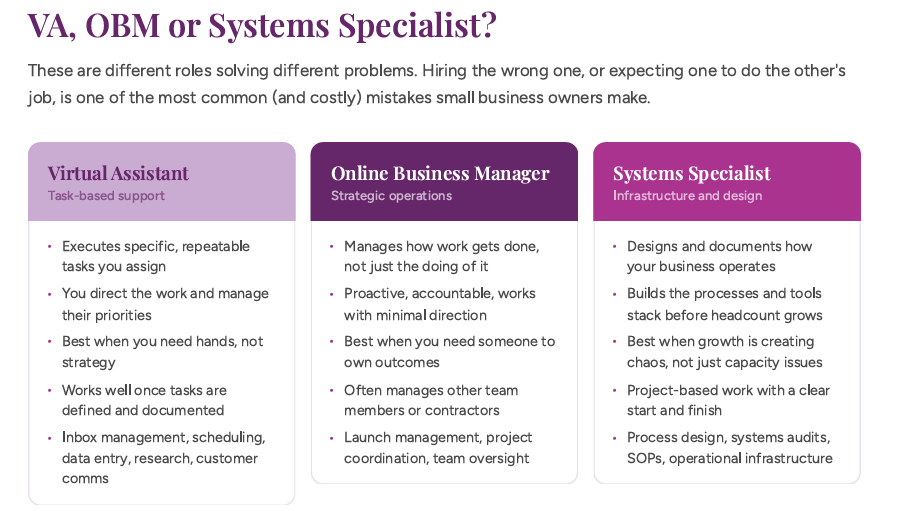
The short answer
Hire a virtual assistant (VA) when you know which tasks you want off your plate, those tasks are documented, and you're happy to direct the work.
Hire an online business manager (OBM) when you need someone to own outcomes and manage how work gets done, including other team members, with minimal direction from you.
Hire a systems specialist when growth is creating chaos, your processes live in your head, and the business needs to be designed and documented before anyone else can run it well.
If you read those three and can't tell which one describes you, start with the third.
The real mistake: hiring before your business can support a team
I understand why it happens. You're at capacity. You're turning down work, or delivering it at 10pm. Hiring feels like the obvious fix, and a VA is the most accessible hire.
A new team member walks into whatever already exists. If the way you onboard clients, follow up leads or deliver your program lives only in your head, that's what they're walking into.
So they ask, and you answer. They guess, and you correct. The hours you hoped to free up go into explaining, checking and redoing.
You could hire the best VA in the country and get the same result. A VA executes the tasks you define. If nothing is defined, there's nothing solid for them to execute.
This is usually when the conclusion gets drawn: "VAs don't work for my business" or "It's easier if I just do it myself." Usually neither is true. The business wasn't ready to hand the work over yet.
What a virtual assistant does (and when a VA is the right hire)
A virtual assistant gives you task-based support. They execute specific, repeatable tasks you assign. You direct the work and set their priorities.
Typical VA work includes:
Inbox management and scheduling
Data entry and CRM updates
Research
Customer communications
Formatting and scheduling content
A VA is the right hire when you need hands, not strategy. They do their best work once tasks are defined and documented, so they know what "done" looks like without checking with you first.
Where it goes wrong is when a VA is hired to figure out how the business should run. "Just take care of it" is a reasonable request for a task with clear steps. For a process that has never been written down, you're asking them to do a different role's job, and then judging them on it.
A VA is a good fit if you can list the tasks you want gone, explain each one in a few steps, and you're comfortable staying the person who sets priorities.
What an online business manager does (and when you need one)
An online business manager is responsible for how work gets done across the business. Where a VA completes tasks, an OBM manages the work: who's doing what, by when, and whether it's on track.
OBMs are proactive and accountable, and they work with minimal direction. They often manage other team members or contractors. Typical OBM work includes:
Launch management
Project coordination
Team oversight and accountability
Keeping deadlines and priorities on track
An OBM is the right hire when you need someone to own outcomes. You hand over "make sure the launch runs" instead of "send these five emails".
The catch is that an OBM manages what exists. Many will improve processes as they go. But if there's no team to manage yet and nothing is documented, you're paying for management while they spend their time building the basics, or managing around the gaps.
An OBM is a good fit if you already have a VA or contractors, the work mostly flows, and the thing holding it back is that every decision and follow-up still runs through you.
What a Systems Specialist does (and why it often comes first)
A systems specialist designs and documents how your business operates. They build the processes and the tools stack before your headcount grows, so new people step into something that works.
Typical systems work includes:
Process design (how leads become clients, how clients are onboarded, how delivery runs)
Systems audits
Standard operating procedures (SOPs)
Setting up and connecting your tools
Operational infrastructure that supports a team
A VA and an OBM are ongoing roles inside your business. A systems specialist works on a project basis, with a clear start and finish. They build the foundation the other two work from, then step out.
The question that tells you whether you need one: is growth creating chaos, or only a capacity problem?
A capacity problem means you know what needs doing and how to do it. You don't have enough hours. More hands will help.
A chaos problem means things fall through the cracks, every client gets a slightly different experience, and you're the only person who knows how most things work. More hands will make this worse, because now more people depend on what's in your head.
A systems specialist is a good fit if you're heading toward hiring (or already have and it's not working), your processes are undocumented, and you want the business to run without you being the answer to every question.
Which role do you need? 5 questions to ask before you hire
Could you write down the steps for the tasks you want to hand over, today? If not, the documentation has to happen before a VA can succeed.
When things go wrong, is it because nobody had time, or because nobody knew how? No time points to a VA. Nobody knew how points to systems work.
Do you already have people whose work needs coordinating? If yes, and you're the one coordinating it, look at an OBM.
Do you want to give away tasks or responsibility? Tasks suit a VA. Responsibility for outcomes suits an OBM.
If you took two weeks off, what would break? If the answer is "most things, because I'm the only one who knows how they work", start with a systems specialist.
The hiring order that works for most growing service businesses
For coaches, consultants and service providers growing from six figures toward seven, each role depends on the one before it.
Step 1: Get it out of your head
Map how your business runs. How a lead becomes a client, how a client is onboarded, how delivery happens, what follow-up looks like. Document it, and set up your tools to support it. This is systems work, and it's the step most people skip.
Step 2: Hand over the doing
With documented processes, a VA can be useful within weeks instead of months. Training them means walking through processes you've already written down. The answers stop living in your Slack history.
Step 3: Hand over the managing
Once you have several people and moving parts, bring in an OBM to own the outcomes. They manage a team working from a shared playbook, and they keep improving it.
Some businesses can skip ahead. If your processes are already documented and working, you may be ready to hire a VA tomorrow. The order matters because each hire builds on what's already in place.
Signs you hired before your business was ready
You spend more time explaining tasks than you save by handing them over
Your VA asks the same questions more than once, because the answer isn't written anywhere
You redo work because it wasn't done "the way you do it"
Every new hire's onboarding starts from scratch
You've had more than one VA "not work out"
You still can't take a week off without things slipping
If several of these sound familiar, replacing the person probably won't change the result. You may not need to work harder at managing them. The underlying system may need to be designed first.
Before You Hire, Get Clear on What You're Handing Over
You can't choose the right role until you can see the work. Most business owners skip this step. They hire on a feeling ("I'm at capacity, I need help") instead of a list, and that's how they end up with a VA doing OBM work or a manager with nothing to manage.
The free VA Priority Planner walks you through getting every task out of your head, sorting it by what matters most, and turning it into one clear list. Once it's on paper, you'll see whether you need someone to do the tasks, someone to own the outcomes, or someone to build the systems first.
And if you already have a VA, you'll have a list you can hand over today.
